The Soccer Speed and Strength program is a specially designed training program for youth soccer athletes to improve speed, agility and quickness through a stepwise approach that works on strength, technique and performance.
Below are two videos from a Nike promotion called "Who is the fastest?" (see www.whoisthefastest.com) ... Note how these soccer athletes use arms for balance and how they lower their centre of gravity as they change direction.
Below is a video of members of the USA Women's National Team (USWNT) doing an agility test.
Please note how they shorten their steps and lower their centre of gravity as they change direction:
Below is a speed test used by Cristiano Ronaldo in a Nike commercial ...
Here is what you can learn by watching this video:
- frequency of steps
- closeness of ball to his feet at all times
- how stable his core is
The use of the arms while running is important for playing soccer.
Arms are used to when accelerating, when balancing as movements with the ball are made, and, most importantly, when changing direction.
Observe the video below to see how Lionel Messi uses his arms as he accelerates forward, as he shifts the ball side to side, and as he changes direction. Not surprisingly, he uses his arms much better than most soccer players. PLEASE focus on his use of arms, as it is very easy to end up watching the ball when he plays. Note that some of the video is in "slow motion" for you to observe carefully as he is very fast in his motions.
The movement of the arms is an essential step towards optimal speed development.
The basic elements of "proper" arm action are as follows:
the shoulders are square and remain relaxed while the arm is able to swing freely (like a pendulum)
the arm is bent at 90 degrees (as coach Danaka Porter says "Keep it in an L-shape") on both upswing and downswing
the downswing takes the hand past your waistband (my youth coach used to refer to sweeping past the top of your tracksuit pockets)
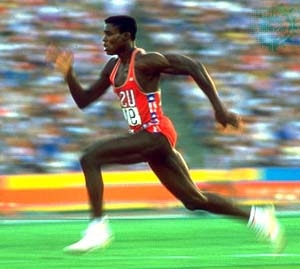
the upswing takes your hand to just below eye level (check out the image of Carl Lewis below)
Here is a simple drill that I recommend athletes do in front of a mirror to observe their own arm action (amazing what some visual feedback can do to refine technique):
Once you have used the visual feedback to refine the arm action, you will need to spend time doing the arm action to become comfortable with it. The seated arm action is an excellent drill that an athlete can do while watching TV (commercial breaks are a good length of time to get some arm action reps done). Here is a video of this drill:
For some more advanced observations, my friend Jimson Lee has an excellent article on arm action on his blog. He likes to quote famous Canadian Track Coach Geoff Gowan , “You run with your arms on your legs”.
The basis of achieving maximum speed require a focus on four key elements:
Arm Action
Body Posture
Leg Action - Ground Contact
Leg Action - Knee Drive
In the figure above, you should note how each of these elements are involved in the running motion of an athlete at full sprint.
Watching a video of current world champion and world record holder Usain Bolt should help you visualize this. When watching the videos, observe how the arms are used, how erect the body posture is, how the sprinters run on the balls of their feet, and how the knees drive forward to establish an optimal stride length.
here is a slow motion analysis of his 100m world record performance in Berlin last year
When we refer to "the Core", we are referring to the muscles that are involved in holding the torso in position. In other words, the abdominal muscles and other muscles involved in positioning the spine and pelvis. These muscles play an important role in coordinating movement.
When an athlete is deficient in core strength, we often notice:
limitations in range of motion when approaching full speed
difficulty in maintaining balance when changing direction
inability to maintain an erect posture when in motion
In soccer players, core strength not only impacts the ability to move fast and change direction quickly, but is vital to the ability to win tackles.
These muscles also play a critical role in injury prevention. Strength in the hips and lower back will prevent many injuries to leg muscles.
In our last training session, I demonstrated a core routine. Here are the steps in my routine:
1. Vertical Leg crunch (click here for guide)
2. Raised Bent Knee Crunch (click here for guide , see animation here)
3. Raised Bent Knee Oblique Crunch - Right Elbow to Left Knee
4. Raised Bent Knee Oblique Crunch - Left Elbow to Right Knee
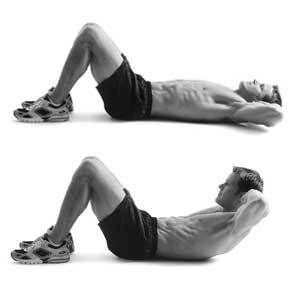
5. Feet-on-ground Bent Knee Crunch (see photo here)
6. Lying Straight Leg Crunch
7. Lying on Right Side Oblique Crunch (click here for guide)
8. Lying on Left Side Oblique Crunch (see animation here)
Here is an 8 minute fitness routine that covers some of the basic core exercises.
And here are some videos on doing the PLANK exercise: